Every visitor eyeing the Grand Canyon Railway asks the same question before booking anything. Why pay for a two-hour train ride when a rental car covers the same ground in about an hour? The honest answer depends on what the trip to the South Rim is actually for. The train and the highway solve two different problems, not the same problem at two different prices.
What a Grand Canyon Railway Ticket Actually Buys
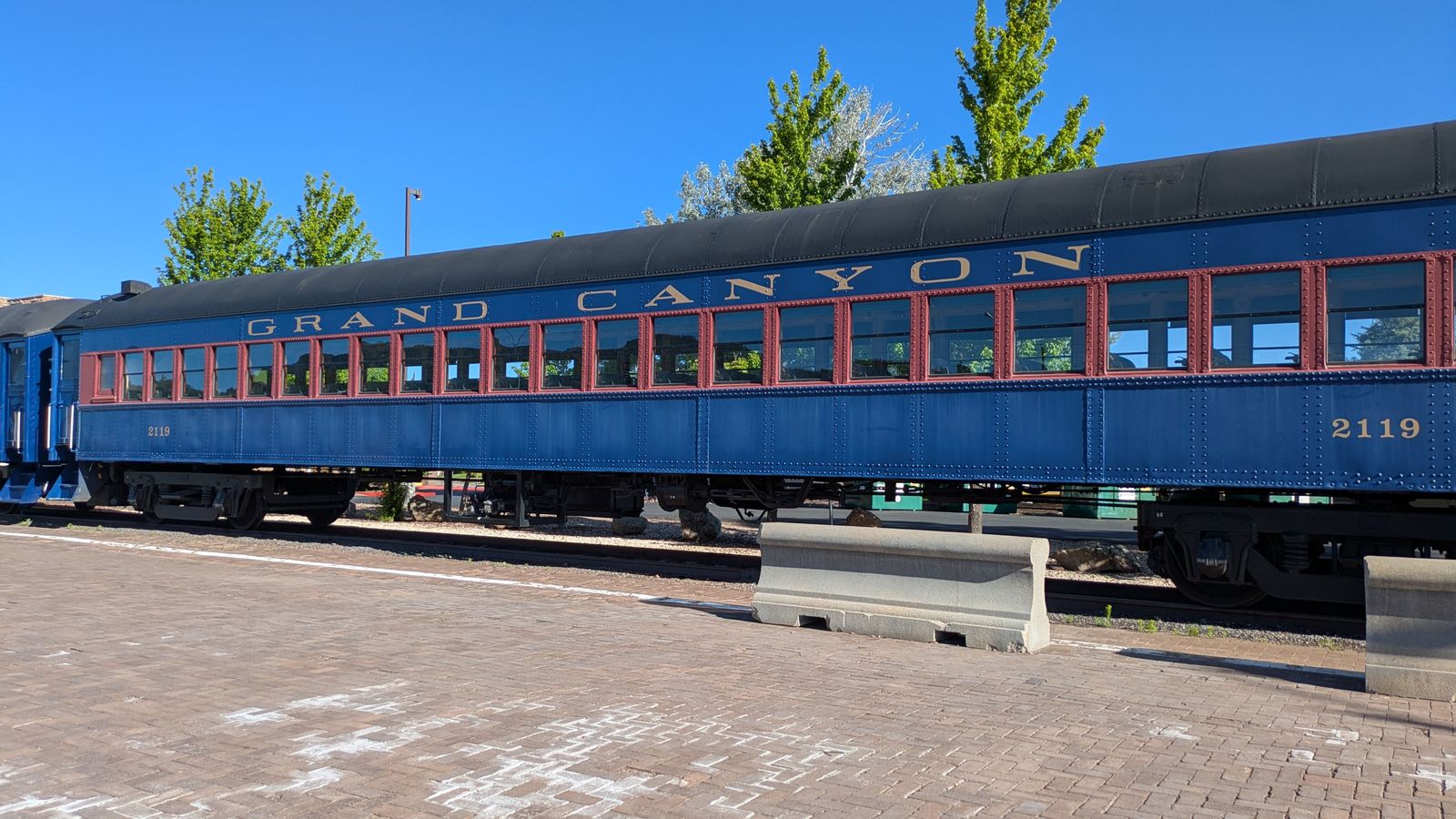
The Grand Canyon Railway runs the same 65-mile route it opened back in 1901. It connects the historic Williams Depot to Grand Canyon Village on the South Rim. Passenger service stopped in 1968, and the track sat unused for two decades. Max and Thelma Biegert revived the line and reopened it on September 17, 1989.
The ride itself takes about two hours and fifteen minutes each way. Riders get more than three hours to explore the rim before the train heads back to Williams. Trains leave Williams at 9:30 a.m. most of the year and return at 5:45 p.m. November and December departures shift earlier, to 8:30 a.m. out and 4:45 p.m. back.
Six classes of service cover very different budgets for 2026:
- Pullman Class: $69.98 adult, $37.98 child. Bench seating, no air conditioning, running March through October only.
- Coach Class: $89.98 adult, $57.98 child. Air-conditioned 1950s-era cars. ADA accessible.
- First Class: $172.98 adult, $132.98 child. Oversized seats, bar service, and complimentary snacks.
- Observation Dome: $202.98 adult, $192.98 child. Dome-level seating and bar service. Not permitted for children under 2.
- Luxury Dome and Luxury Parlor: $242.98 per adult. Private bar service and rear platform access. Adults only.
For 2026, the railway is also running a Route 66 centennial promotion. Coach Class tickets drop to $66 with the code ROUTE66. Two blackout weeks apply, March 7 through 15 and March 28 through April 5.
The fare buys more than a seat and a view. A Wild West shootout plays out at the Williams Depot before the morning boarding call. Roaming performers work the aisles once the train gets moving. They play out a running bit involving the Cataract Creek Gang and a Grand Canyon Railway Marshal. None of that happens on the drive up Highway 64.
Choosing a class comes down to how the day is spent, not just the budget. Coach Class covers most travelers fine, since it runs air-conditioned and the views out the window are the same ones First Class passengers get. Pullman only makes sense in mild weather, since there's no air conditioning to fall back on if the desert heat shows up early. First Class and the dome cars earn their higher price mainly for a special-occasion trip, an anniversary or a milestone birthday. They also suit a family that wants snacks and bar service included, rather than bought separately in the café car.
What Driving Costs Instead
Skipping the train means covering the distance yourself. Williams to the South Rim entrance is 59 miles. The drive runs about an hour and five minutes, out Route 66 and then north on Highway 64 through Tusayan.
A private vehicle pays a flat $35 entrance fee at the gate, use our cost calculator to check the total for your group and pass options. That fee covers everyone inside the car for seven full days, van included. Split three or four ways, it undercuts a single train ticket fast, even at Pullman Class prices.
One new cost applies no matter how a visitor arrives. Starting in 2026, non-U.S. residents 16 and older owe an extra $100 per person at the entrance station. An annual pass or an America the Beautiful pass waives it. That charge has nothing to do with train versus car, but it belongs in either budget.
Where the Train Actually Wins
The train's real value isn't speed. Nobody boards a two-hour train to beat a one-hour drive. It wins on everything else about the day.
There's no parking to hunt for once the train arrives at the rim. There's no fatigue from two hours behind the wheel on unfamiliar mountain roads. There's no risk of a missed turn eating into canyon time. Kids get an actual experience built into the transportation itself, not just a back seat and a screen.
The fixed schedule does something a rental car can't. It forces a hard start time and a hard end time. That structure helps the visitor who always lingers a little too long at the last overlook and nearly misses dinner. For anyone staying at the Grand Canyon Railway Hotel in Williams the night before, the whole day becomes one self-contained package. No highway. No entrance line. No decision beyond which class of ticket to book.
Where Driving Wins
Driving wins on flexibility, and for most first-time visitors, flexibility matters more than atmosphere. A car means stopping at several viewpoints along Desert View Drive instead of arriving at one fixed spot. It means adjusting the whole day on the fly. It means staying past 5:45 p.m. if watching the sunset is actually the point of the trip.
A car also opens up the rest of the South Rim that the train never touches. Desert View Watchtower sits 23 miles past Grand Canyon Village, well outside a walkable range from the depot. So do most of the pullouts along the drive in from Tusayan. A train passenger sees the village and the rim trail near it. A driver sees whatever stretch of the park they choose to cover.
Driving is also the cheaper option for anything bigger than a solo traveler or a couple. A family of four in Coach Class blows past the $35 vehicle fee before anyone even reaches the entrance gate. A car allows a same-day detour through Tusayan for lunch, gas, or a forgotten jacket. None of that fits into a train schedule built around one departure and one return.
Neither option is the objectively better choice here. The train fits visitors who want the journey to be part of the vacation itself. It fits families with kids who will remember a staged train robbery longer than a canyon overlook. It fits anyone who would rather not drive mountain roads at all.
Driving fits visitors who want the most possible time at the rim. It fits anyone planning to see more than one viewpoint in a day. It fits groups large enough that the per-person train math stops making sense.
Either choice lands in the same place: the South Rim of Grand Canyon National Park. That's worth saying plainly. The North Rim, the West Rim, and Havasupai each sit hours away on their own separate systems. Neither the train nor this drive gets a visitor anywhere near them.
Compare current ticket pricing directly with the railway before booking. Then check nearby South Rim lodging and dining options for whichever end of the trip needs a place to stay.