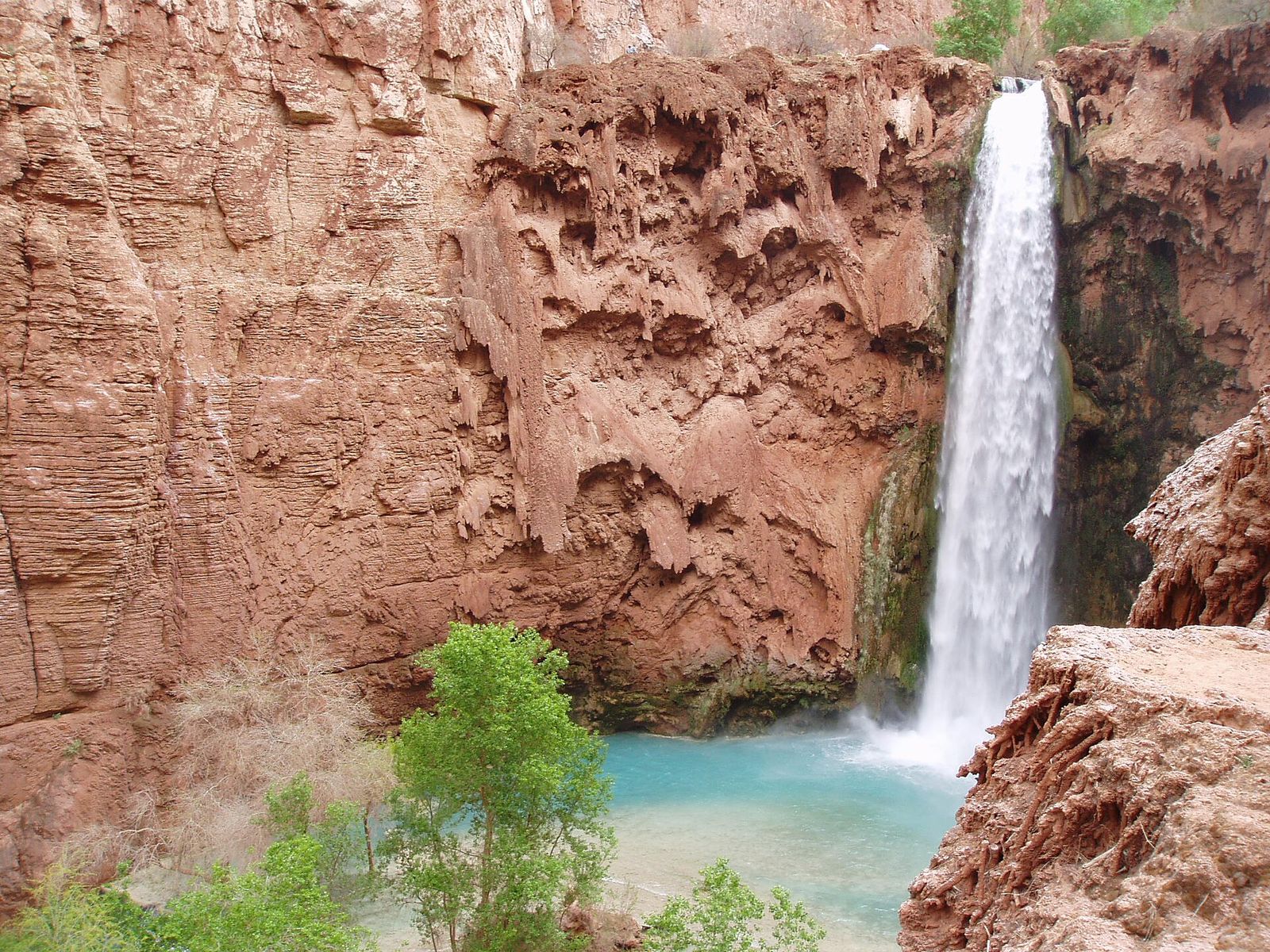
Havasu Falls is the turquoise waterfall you've seen on every "most beautiful places in Arizona" list, and it's a genuinely different trip from visiting Grand Canyon National Park itself. Havasu Falls, Supai Village, and the trail to reach them all sit on the Havasupai Reservation, land belonging to the Havasupai Tribe, west of the park and reached by an entirely separate road and permit system. This guide covers what's actually true: how the permits work, what the hike involves, and what you'll find once you're there.
Havasu Falls Is Not Inside Grand Canyon National Park
Worth saying plainly up front, because it changes how you plan: Havasupai land is a sovereign tribal reservation bordering the western Grand Canyon, not a section of the National Park you'll find on a typical South Rim park map. There's no shared entrance, no shared shuttle system, and no NPS park pass that gets you in. Everything, including the permit, the trailhead, the campground, and the falls, is managed entirely by the Havasupai Tribe through their own reservation system.
How to Get a Havasu Falls Permit
Permits are the entire bottleneck. They're sold exclusively through havasupaireservations.com, the tribe's own official system. Any other site selling or reselling permits is not legitimate; permits are non-transferable outside the tribe's own transfer process (more below).
- Early access: opens January 21 at 8:00 AM Arizona time and runs through January 31 at 5:00 PM, for an extra fee, giving first pick of dates.
- Standard reservations: open February 1 at 8:00 AM Arizona time for the entire coming season.
- Season: permits run February 1 through November 30 each year. The reservation, trail, and campground are closed in December and January.
Permits routinely sell out within hours of opening, sometimes within minutes for the most popular spring and fall dates, a demand level that rivals the South Rim's own permit system for backcountry hikes like the Bright Angel Trail. If you have flexible dates, weekday check-ins and less popular months (June/July's heat, or dates just after reopening in February) are the more realistic way in without being online the exact second sales open.
Camping vs. the Lodge
There are two ways to stay, both requiring a 3-night minimum:
- Campground: $455 per person for 3 nights, scaling with group size: a solo permit costs $455, a group of four costs $1,820 combined. You pitch a tent anywhere along the creek within the designated camping area. Fees include entry, camping, and environmental fees.
- Havasupai Lodge (in Supai Village): $2,277 per room for 3 nights, flat regardless of group size up to 4 people. Rooms have two queen beds, a private bathroom, bedding, and towels. The lodge sits in the village itself, 2 miles short of the campground and falls.
Both are booked as one continuous reservation through the same online system, so there's no walk-up option and no way to book only a single night.
Cancellations and Transfers
Cancel 90+ days before your permit's start date and you get a 50% refund of the permit fee (the early-access fee itself is non-refundable). Cancel within 90 days and the reservation is non-refundable outright. Permits cannot be resold or transferred privately; the only legitimate way to pass along a reservation is through the tribe's official Transfer System, either directly to another approved trip leader or via the public cancellation/transfer waitlist. At check-in, the group needs valid photo ID matching the reservation; the original booker doesn't have to be the one who shows up, as long as someone listed on the permit does.
The Hike: Hualapai Hilltop to the Falls
The trailhead is Hualapai Hilltop, not a road inside the park. It's reached via Indian Road 18, a paved but remote road with open-range livestock, about 60 miles from the Route 66 turnoff near Grand Canyon Caverns. Budget at least 1.5 hours just for that final stretch, and know that cell service disappears well before you arrive.
- Distance: 8 miles from Hualapai Hilltop down to Supai Village, then 2 more miles to the campground and the falls: 10 miles one-way, 20 round trip.
- Difficulty: The trail itself is well-maintained but rocky with loose scree in places. Going in is a net descent and easier than people expect; hiking back out is the harder half, since it's a steady uphill climb the whole way with your full pack.
- Water: None available anywhere along the trail, so carry everything you'll need for the descent.
- Heat: Summer temperatures regularly exceed 100°F in the canyon, and the trail closes outright if it hits 115°F or above. Most hikers start before sunrise for exactly this reason.
Skipping the Hike: Helicopter and Mule Options
Two ways to avoid carrying a full pack the whole way:
- Helicopter: Flies between Hualapai Hilltop and Supai Village on Sundays, Mondays, Thursdays, and Fridays. It's first-come, first-served with no advance booking (you show up and wait your turn) for around $100 one-way. Locals get priority, so plan for a possible long wait, especially on your way out.
- Mule service: For around $400 round-trip, a mule packer will carry your gear (not you) between the Hilltop and the campground. Bags need to be dropped off by 10:00 AM at the trailhead.
Note that a permit is still required either way: the helicopter and mules move gear and people, they don't substitute for the reservation.
Day hikes are not permitted. Every visitor needs an overnight permit (campground or lodge); there's no version of this trip where you hike in and out in a single day.
The Waterfalls
Five named waterfalls sit along Havasu Creek, a tributary that owes its striking turquoise color to a high mineral (travertine) content:
- Havasu Falls: the iconic one, right by the campground entrance, with a wide pool at its base perfect for swimming.
- Mooney Falls: about half a mile past the campground, and at 190+ feet the tallest of the group. Reaching the pool at its base means descending a narrow, chain-assisted passage cut into the cliff by 1900s-era miners, not difficult, but not for anyone uneasy with exposure.
- Beaver Falls: roughly 3 miles beyond Mooney, a series of shallower travertine-terraced pools that's the best spot on the creek for a long, easy swim. Getting there involves a couple of creek crossings and a bit of scrambling.
- Navajo Falls and Fifty Foot Falls: smaller, closer to the village, and an easy add-on rather than a destination hike on their own.
The creek itself runs a consistent, refreshingly cool 70°F year-round, regardless of the air temperature above it.
Best Time to Visit and Weather
Late spring (late April-May) and early fall (late September-October) are the sweet spot: warm enough to swim during the day, cool enough at night, and outside the worst of the heat. They're also, unsurprisingly, the hardest permits to get. Summer (June-August) runs consistently over 100°F with the trail-closure risk noted above. The reservation closes entirely in December and January, and even in the shoulder months of November and February, overnight temperatures can drop below freezing with occasional snow. Flash flooding is a real, sometimes fatal risk in this canyon system, so always check the current forecast in the days before you go, not just when you book months in advance.