Rangers get asked more than once a season if Bright Angel Trail has an elevator. The people asking are rarely joking. One water bottle and a level of confidence that borders on medical is the standard starting kit for a hiker about to learn exactly what this trail demands.
Bright Angel is the classic South Rim corridor trail. It is the one most first-time hikers mean when they say they are "doing the Grand Canyon." The trailhead sits inside Grand Canyon Village at 6,860 feet. From there the path drops through a series of switchbacks that make the first mile feel deceptively gentle. That is the trap built into this hike. Everything you walk downhill has to come back up, and the return trip is where most rescues happen.
The trail marks itself in stages, which sounds obvious until you notice how many people skip reading them before they start. Mile-and-a-Half Resthouse sits exactly where the name promises. It has vault toilets open year-round and an emergency phone tied directly to park dispatch. From May through October there is also a water filling station here. The pipe that feeds it is old and prone to breaking in freezing weather, which is why it only runs reliably in the warmer months.
Time estimates help more than mileage alone on this trail. The out-and-back to Mile-and-a-Half Resthouse, a 3-mile round trip, typically takes most hikers 2 to 4 hours. Add real time for the climb back up past Three-Mile Resthouse and Havasupai Gardens. The return leg on Bright Angel almost always takes longer than the way down, never less. Budget accordingly, and start earlier than feels necessary rather than later.
Three-Mile Resthouse is the next real checkpoint, about a mile and a half further and roughly 900 feet lower. It shares the same seasonal water window, May through October, but it has no restroom. There is an emergency phone here as well. Treat both resthouses as checkpoints, not destinations in themselves. A lot of hikers stop here for lunch and call it a day. Honestly, that is the right instinct for a first visit.
Keep walking and the trail reaches Havasupai Gardens at mile 4.5, elevation 3,800 feet. It is named for the Havasupai people, who farmed this spot long before the trail existed. Do not confuse it with the Havasupai Reservation itself. That is a separate sovereign tribal land, reached by a completely different trailhead hours from here. It gets its own guide elsewhere on this site. Havasupai Gardens is the one place on the corridor with water year-round, along with shade, restrooms, and a ranger station. For most day hikers, it is also the real point of no return. Everything past it adds serious distance and elevation to an already long walk back up.
A side trail from Havasupai Gardens leads to Plateau Point, a 12-mile round trip from the rim with about 3,080 feet of total elevation change. The view from the point is one of the best on the entire hike, looking straight down into the inner gorge. As of this writing, the final stretch of that side trail is closed through June 30, 2026 for waterline construction. Check the current status on nps.gov/grca before you build a hike around it, since park construction timelines shift.
The Colorado River and Phantom Ranch sit 9.9 miles below the rim, a drop of roughly 4,380 feet. The National Park Service does not recommend hiking down to the river and back in a single day. Rangers are not exaggerating for effect. Summer temperatures on the exposed lower trail can climb past 120 degrees. Most heat-related rescues happen to hikers who are still moving between 10 a.m. and 4 p.m. That is exactly the window rangers ask you to avoid.
Rangers call the fix "hike smart," which is a friendlier phrase than what they are probably thinking. Start before 10 a.m. so you clear the hottest, most exposed sections early. Rest in the shade through the middle of the day. Get moving again after 4 p.m. if you still have ground to cover. Eat something salty along with your water, because a gallon of plain water on an empty stomach does not fix dehydration. It just trades one problem for another. Hikers running on a walk-fast-worry-later strategy tend to learn that lesson the hard way, usually somewhere around mile three.
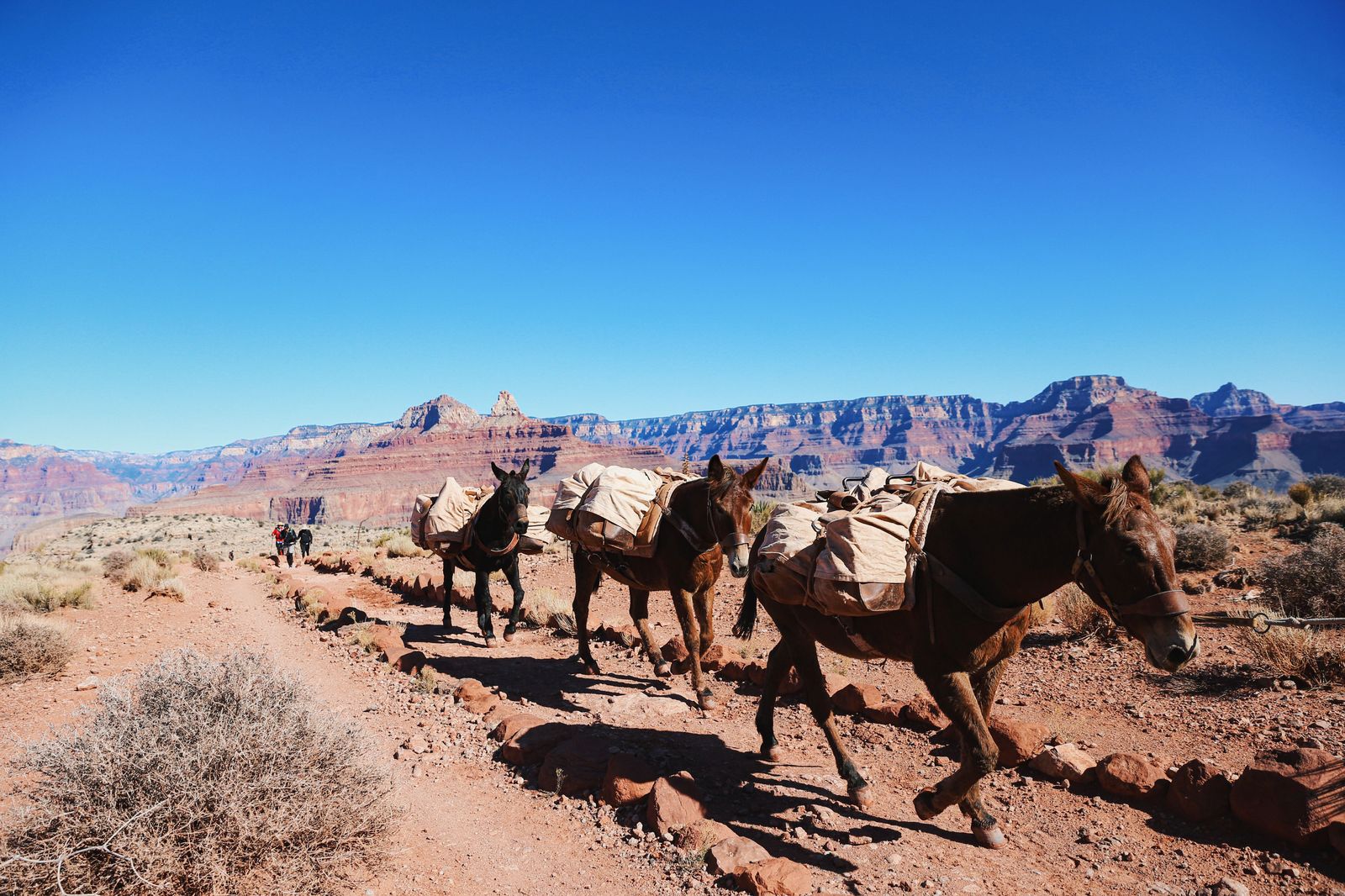
Bright Angel is also the busiest corridor trail in the park, especially in the first mile near the rim. Expect company at every viewpoint and resthouse, particularly on weekends and holidays. Mule trips into the canyon run on this trail regularly, carrying both riders and supplies down to Phantom Ranch. When you meet a mule train, step to the uphill side of the trail and stay quiet. Follow whatever the wrangler leading them tells you to do.
Getting to the trailhead itself is the easy part. It sits right in Grand Canyon Village, walkable from the South Rim's main lodges. It is also a stop on the free park shuttle for anyone staying further out. Parking near the trailhead fills early on busy mornings. Hikers coming from Tusayan or Williams should plan to catch the shuttle rather than circle for a spot. There is no fee to hike Bright Angel beyond the park's standard entrance fee. No permit is required for a day hike of any length, all the way to the river.
What you carry matters more on this trail than on almost any other in the park. Bring more water than feels necessary, plus electrolytes or salty snacks to go with it. Sun protection is not optional on a trail with almost no shade below the rim. A headlamp earns its weight if there is any chance you are still moving at dusk. None of this is exotic advice. It is just the advice that gets ignored most often. Usually the people ignoring it assumed the walk down would tell them the truth about the walk back up.
Spring and fall mornings are the sweet spot for this hike. The air is cool enough for the climb back up, and the crowds thin out compared to the peak of summer. Winter brings ice on the upper switchbacks, which is worth planning around with traction devices rather than skipping the hike altogether. Whatever season you choose, the core rules do not change. Know your turnaround point, carry more water than feels reasonable, and respect how much longer the climb out takes than the walk in.
Not everyone stops at the edge of a single day. Overnight stays below the rim, at Bright Angel Campground or Phantom Ranch, require their own permit or reservation, entirely separate from anything covered here. That system runs on a lottery, fills fast, and deserves its own guide rather than a rushed mention at the bottom of this one.
Bright Angel is not dangerous because the trail itself is bad. It is dangerous because the top of it is comfortable enough to make people forget how far down the bottom actually sits. Pack more water than you think you will need, see our packing checklist for the full list. Not sure Bright Angel is the right trail for your group? Try our hike picker. Turn around earlier than you want to. The canyon will still be here next time, and with a little planning, so will you.